
Last Updated: 2 November 2026
Quick Summary
Professional asbestos inspection services in the UK combine a physical site survey, material sampling, laboratory analysis and a written report identifying what asbestos is present, where it is and its condition. The survey type you book depends on your plans: a management survey for occupied buildings staying in use, or an intrusive refurbishment and demolition survey when the building fabric will be disturbed.
- Regulation 4 of the Control of Asbestos Regulations 2012 places a duty to manage asbestos risk on those responsible for non-domestic premises.
- Booking a management survey for a demolition project is a common and expensive mistake that stalls the project.
- Check the UKAS schedule of accreditation, as a firm accredited only for laboratory analysis may not be accredited to carry out surveys.
- A compliant report must state areas not accessed, because that limitation protects you.
- Property Group works to rapid 24/48 hour turnaround on surveys, with analysis by ISO 17025 accredited laboratories.
Table of Contents
- What Professional Asbestos Inspection Services Actually Cover
- Choosing the Right Survey: Management Survey vs Refurbishment and Demolition Survey
- How to Verify Accreditation and Competence Before You Book
- Asbestos Survey Cost: What Drives the Price and How to Compare Quotes
- What a Compliant Asbestos Survey Report Must Contain
- Sampling, Laboratory Analysis and Turnaround Times
- Domestic, Commercial and Industrial Properties: What Changes
- Get a Quote for Professional Asbestos Inspection Services
- Frequently Asked Questions
What Professional Asbestos Inspection Services Actually Cover
Professional asbestos inspection services in the UK are not a single visit with a clipboard. They combine a physical site survey, material sampling, laboratory analysis and a written report that tells you what asbestos is present, where it is, and what condition it is in.
The legal backdrop matters here. Regulation 4 of the Control of Asbestos Regulations 2012 places a duty on anyone responsible for maintenance and repair of non-domestic premises to manage asbestos risk, and the Health and Safety Executive’s guidance on duty to manage asbestos sets out what that duty actually requires in practice.
What an inspection typically involves:
- A site walkthrough to identify suspected asbestos-containing materials (ACMs)
- Sample collection from materials that could reasonably contain asbestos
- Laboratory analysis of each sample
- A written survey report with a material assessment and recommendations
The survey type you book changes what the inspector does on site. That is where most people get it wrong, and it is the first thing to settle before you request a quote.
Choosing the Right Survey: Management Survey vs Refurbishment and Demolition Survey
The right survey depends entirely on what you plan to do with the building. A management survey keeps a building in use and tracks ACMs over time. A refurbishment and demolition survey is intrusive and strips back the fabric so contractors can work safely. Booking the wrong one wastes money and can leave you non-compliant.
When a Management Survey Is Enough
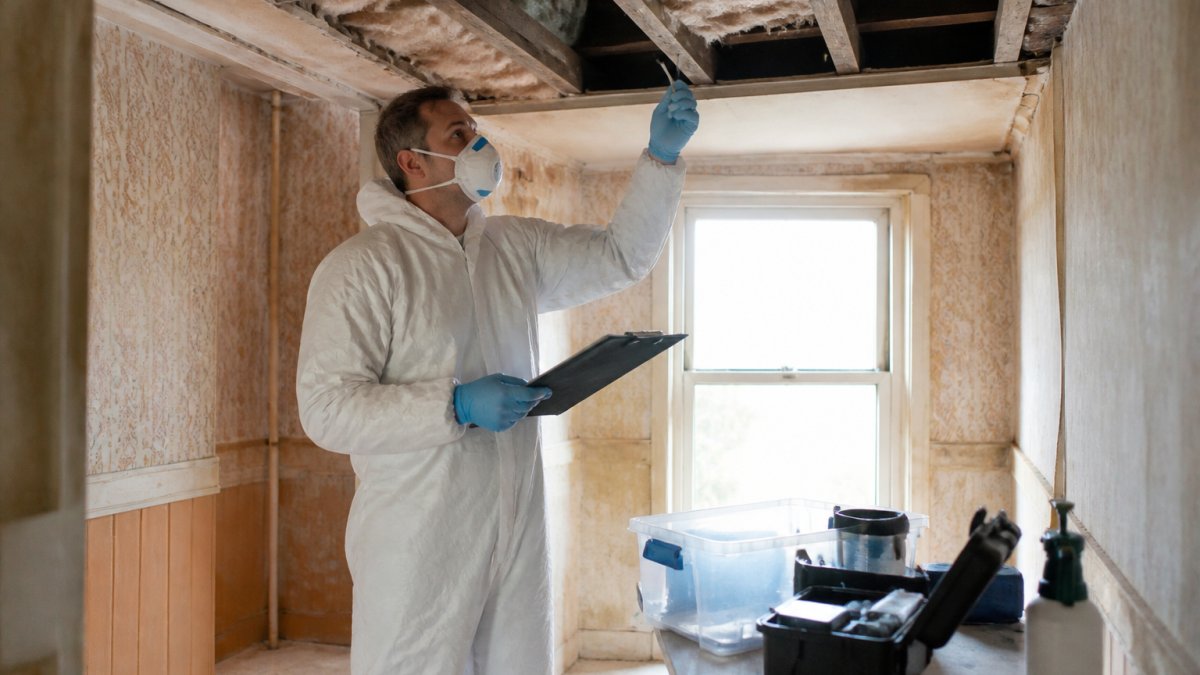
A management survey is the standard choice for occupied buildings that will stay in use. The surveyor inspects accessible areas and samples materials that are likely to contain asbestos, without causing damage beyond minor access points.
Landlords letting a property, property managers maintaining a portfolio, and dutyholders building an asbestos management plan all need this survey. The output feeds directly into an asbestos management plan, which records where ACMs are, their condition, and how they will be monitored.
If nothing is being stripped out, drilled into or demolished, a management survey covers your legal position.
When You Need a Refurbishment and Demolition Asbestos Survey
A refurbishment and demolition asbestos survey is required whenever the building fabric will be disturbed. That includes full demolition, strip-out, major refurbishment, and often smaller works like removing a ceiling or knocking through a wall.
This survey is intrusive by design. The surveyor accesses voids, risers, roof spaces and enclosed areas that a management survey leaves alone. The goal is to locate all ACMs before anyone puts a tool into the structure, because disturbing asbestos is where the real health risk begins.
Watch out: booking a management survey for a demolition project is a common and expensive mistake. Contractors cannot safely start work without the intrusive survey, and the project stalls while the correct survey is arranged.
| Survey type | Best for | Intrusive? | Output |
|---|---|---|---|
| Management survey | Occupied buildings staying in use | No | Asbestos management plan |
| Refurbishment survey | Refurbishment and strip-out projects | Yes | Pre-works ACM register |
| Demolition survey | Full demolition | Yes | Full ACM location report |
How to Verify Accreditation and Competence Before You Book
Accreditation is the first thing to check, and it is where a lot of cheap quotes fall apart. UKAS is the official body that assesses laboratories and inspection bodies against recognised standards, and the UKAS directory of accredited asbestos laboratories lets you check a claim in minutes.
But accreditation is not a single tick, it has a scope. When you check the UKAS directory, look at the specific schedule of accreditation. It should list the types of survey the body is accredited for (management, refurbishment and demolition) and the activities covered (sampling, analysis, reporting).
Beyond paperwork, competence comes down to training and experience. BOHS and UKATA certifications show the surveyor has been trained to recognised industry standards. The key qualifications are:
A surveyor who cannot produce these on request is not someone you want signing off a report you may later rely on in a dispute. Ask how many surveys they have completed on properties like yours, and whether they carry insurance.
A short checklist before you book:
- UKAS accreditation for surveying confirmed, with the scope checked
- Laboratory accreditation confirmed for analysis (ISO 17025)
- BOHS P402 or UKATA certification for the surveyor
- Public liability and professional indemnity insurance in place
- Sample report provided so you can judge the quality
- Written scope confirming exactly what the survey covers and what will not be accessed
If you want a plain-English walkthrough of what an inspection looks like from the inside, our guide on how to check for asbestos in older homes covers the process step by step.
Asbestos Survey Cost: What Drives the Price and How to Compare Quotes
Asbestos survey cost is driven by scope, not by a standard rate card. Property size, the number of buildings, how many samples are taken, access difficulty and turnaround time all move the number. That is why a quote given over the phone without a site discussion is worth very little.
| Property type | Management survey (indicative) | Refurbishment/demolition survey (indicative) |
|---|---|---|
| Flat or small terraced house (1-2 bedrooms) | £250-£450 | £400-£700 |
| Three-bed semi-detached house | £350-£600 | £550-£900 |
| Large detached house (4+ bedrooms) | £500-£850 | £800-£1,400 |
| Small commercial unit (up to 500 m²) | £450-£800 | £700-£1,200 |
| Warehouse or industrial unit (500-2,000 m²) | £800-£1,800 | £1,200-£2,500 |
The main cost drivers:
- Property size and layout. A three-bed semi and a warehouse are not comparable jobs.
- Survey type. Refurbishment and demolition surveys take longer than management surveys because they are intrusive.
- Number of samples. Each sample carries a laboratory analysis charge.
- Access. Locked voids, fragile roofs and occupied buildings slow the work and may add labour.
- Turnaround. Faster reporting may cost more.
When you compare quotes, compare like for like. A cheap quote that covers half the building, excludes laboratory fees or omits the report is not cheaper, it is incomplete. Ask every provider to state the survey type, number of samples, report format and expected turnaround in writing.
Pricing depends on the property, the survey type and the scope. Visit the Property Group website or request a quote with the property details for current prices.
What a Compliant Asbestos Survey Report Must Contain
A compliant survey report is a document you can hand to a contractor, a solicitor or an enforcing authority without embarrassment.
The report should contain:
- Property details and survey scope, including areas not accessed
- A register of ACMs with location and photographs
- Material assessment scores and risk ratings
- Recommendations for management or removal
- Laboratory certificates for every sample analysed
- Surveyor details and accreditation references
The HSE’s guidance on asbestos surveys and sampling sets out the standard a survey should meet, and a report that skips the material assessment or the recommendations is not compliant. If asbestos is later found and someone falls ill, this documentation is what demonstrates you took reasonable steps.
What most guides miss is the “areas not accessed” section. A good report states clearly what the surveyor could not reach, because that limitation protects you. A report claiming full coverage when voids were locked is a liability.
Sampling, Laboratory Analysis and Turnaround Times
Sampling and laboratory analysis are where the timeline is set. Each sample is collected on site, sealed, and sent to an accredited laboratory for analysis. The report cannot be finalised until every result is back, so turnaround is a function of sample volume and lab capacity.
A typical inspection follows this sequence:
- Site survey and sample collection
- Samples transported to the laboratory
- Laboratory analysis of each sample
- Results compiled into the survey report
- Report issued with recommendations
Turnaround varies with the number of samples and the urgency of the job. If you are in a property transaction or a project start date is looming, say so at the quoting stage, because priority handling is usually available. Property Group works to rapid 24/48 hour turnaround on surveys, with analysis handled by ISO 17025 accredited laboratories.
Domestic, Commercial and Industrial Properties: What Changes
The property type changes the survey, the risks and the paperwork. A domestic property usually means a single building with a straightforward scope. Commercial premises bring dutyholder obligations under CAR 2012 and often a need to keep the building operational during the survey.
For landlords with several properties, the practical issue is coordination. Running surveys across a portfolio with one provider keeps the reporting consistent and the management plans comparable, rather than juggling reports in different formats from different firms.
Construction and refurbishment project managers have the tightest requirement of all. Under the Construction (Design and Management) Regulations 2015, asbestos information must be shared across the project team, and a refurbishment and demolition survey is the document that makes that possible.
Get a Quote for Professional Asbestos Inspection Services
The gap between a cheap survey and a compliant one shows up months later, usually when a solicitor, contractor or buyer asks for documentation you do not have. Book the right survey, from an accredited provider, and keep the report.
Property Group provides professional asbestos inspection services in the UK for homeowners, landlords, property managers and construction teams. Our surveyors are BOHS and UKATA certified, our laboratories are ISO 17025 accredited, and our surveys are compliant with CAR 2012 legislation. We offer rapid turnaround, clear reports and honest advice on what happens next if asbestos is found.
Get started with Property Group and get a survey report you can rely on when it matters. Request your quote today.
Frequently Asked Questions
What does a professional asbestos inspection include?
A professional asbestos inspection covers a physical site survey of the property, identification of asbestos-containing materials (ACMs), condition and material assessment, and sample collection where needed. Samples go to a laboratory for analysis, and the findings are set out in a written asbestos survey report with recommendations. The surveyor should be trained and certified, and the work should follow current HSE guidance and CAR 2012 duties so the documentation stands up if it is challenged later.
How much does an asbestos survey cost?
Asbestos survey cost depends on the size and age of the property, the survey type, the number of samples taken and access arrangements. A management survey on a small domestic property sits at a different level to a refurbishment and demolition survey on a commercial building. Rather than rely on a headline figure, compare quotes on a like-for-like basis: same scope, same sample allowance, same report format. Ask for a written quote before work starts.
How do I choose a qualified asbestos surveyor?
Check three things. First, accreditation and certification: surveyors should hold BOHS or UKATA credentials, and laboratories should be ISO 17025 accredited. Second, insurance. Third, a sample report so you can see how findings, material assessments and recommendations are presented. A provider that cannot show credentials or a sample report before booking is a risk you do not need to take, especially given the penalties for non-compliance.
Do landlords need an asbestos survey?
Landlords have duties under the Control of Asbestos Regulations 2012 to manage asbestos risk in the common areas of rented property. A management survey is the usual starting point: it locates ACMs that are in good condition and sets out how to monitor them. If you are refurbishing between tenancies, a refurbishment and demolition survey may be needed first. Keep the survey report and asbestos management plan on file, because solicitors and buyers will ask for them during a sale.
