
Table of Contents
- Why You Need an Asbestos Survey Before Home Renovation
- Asbestos Management Survey vs Refurbishment Survey
- Your Legal Responsibilities for Homeowners Under CAR 2012
- What Happens During an Asbestos Survey for Home Renovation
- How Much Does an Asbestos Survey Cost?
- Asbestos Air Testing Procedure for Homeowners
- If Asbestos Is Found: Removal, Disposal and Reassurance
- Frequently Asked Questions
Last Updated: 27 September 2026
Why You Need an Asbestos Survey Before Home Renovation
An asbestos survey for home renovation is a formal inspection that identifies asbestos-containing materials before any building work disturbs them. If your property was built or refurbished before the year 2000, asbestos could be present in ceiling tiles, pipe lagging, floor tiles, or cement sheeting (Diagrams showing where asbestos can occur in buildings). Disturbing those materials during a loft conversion or kitchen knock-through can release invisible fibres into the air.
The Health and Safety Executive is blunt on this point: asbestos remains the single greatest cause of work-related deaths in the country, and tradespeople are among the most exposed groups. Homeowners rarely realise that a weekend of drilling can create a hazard that lasts decades.
This guide from Property Group covers the survey types, the law, and the process, so you can plan your renovation with confidence rather than guesswork.
Asbestos Management Survey vs Refurbishment Survey
The two survey types answer different questions, and choosing the wrong one is a common and expensive mistake.
An asbestos management survey is a non-intrusive inspection that locates asbestos-containing materials likely to be disturbed during normal occupancy. It is the standard survey for landlords managing a property in its current state.
A refurbishment survey is intrusive. It opens up voids, lifts floorboards, and samples materials in the exact areas your building work will touch. If you are knocking through a wall or replacing a roof, this is the survey you need.
| Survey Type | Intrusiveness | Best For | Disturbs Materials? |
|---|---|---|---|
| Management survey | Non-intrusive | Ongoing occupancy, lettings | No |
| Refurbishment survey | Intrusive | Renovation, demolition | Yes, in target areas |
| Demolition survey | Fully intrusive | Full strip-out | Yes, throughout |
Get this wrong and you may pay for a management survey that legally cannot support your renovation. The refurbishment survey is the one that protects your project.
Your Legal Responsibilities for Homeowners Under CAR 2012
The Control of Asbestos Regulations 2012 (CAR 2012) place a legal duty on anyone responsible for maintenance and repair of non-domestic premises to manage asbestos risk (The Control of Asbestos Regulations 2012). For domestic properties you own and occupy, the picture is more nuanced, but it is not a loophole.
Under the Control of Asbestos Regulations 2012, the duty to manage applies to the “dutyholder” responsible for maintenance and repair. If you let a property, employ contractors, or commission building work, you carry obligations. You must identify asbestos before work begins and pass that information to anyone who might disturb it.
Where homeowners get caught out is not the survey itself but the failure to share findings. If a builder drills into a wall and later falls ill, the paper trail matters. A clear, accredited report is your evidence of reasonable care.
What Happens During an Asbestos Survey for Home Renovation
A surveyor will typically arrive on site, agree the scope with you, then work room by room through the areas your renovation touches. Expect the process to take anywhere from an hour for a small loft to most of a day for a full refurbishment.
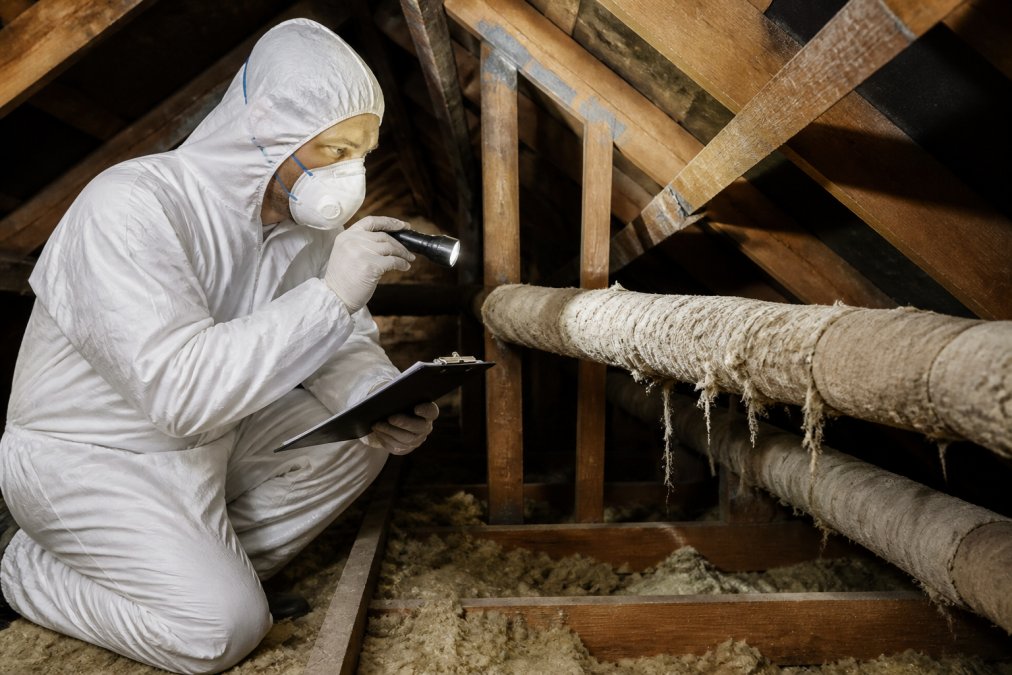
Here is what to expect, step by step:
- Scope agreement: The surveyor confirms which areas your renovation affects.
- Visual inspection: Every accessible surface in those areas is checked.
- Sampling: Small samples are taken from suspect materials and sent to a laboratory.
- Reporting: You receive a written report identifying any asbestos, its condition, and its location.
The samples go to a laboratory accredited to ISO 17025, the international standard for testing competence. At Property Group, our BOHS and UKATA certified surveyors follow this same discipline, with reports typically turned around rapidly.
Ask for the laboratory accreditation number before you book. A survey is only as good as the lab behind it, and a report without an accredited test result will not stand up in a dispute.
How Much Does an Asbestos Survey Cost?
Pricing for an asbestos survey depends on the size of the property, the number of samples required, and how intrusive the survey needs to be. A single-room refurbishment survey on a small property sits at the lower end; a full demolition survey on a large period home sits at the top.
Several factors push the cost up:
- Property size and number of rooms in scope
- Number of samples taken and laboratory-tested
- Access difficulty (lofts, cellars, sealed voids)
- Turnaround time, if you need results urgently
Because every property is different, we do not publish a flat rate. Request a quote based on your actual scope and you will get a figure you can rely on.
Asbestos Air Testing Procedure for Homeowners
The asbestos air testing procedure for homeowners measures fibre concentrations in the air, usually after removal work or before reoccupying a space. It confirms whether an area is safe to use.
A pump draws a known volume of air through a filter over a set period. The filter is then analysed under a microscope to count airborne fibres. Results are compared against the control limit set out in CAR 2012.
Air testing is not a substitute for a survey. It tells you what is in the air right now, not what is hidden in the walls. Use it after removal, during a dispute, or when you suspect disturbance has already occurred.
If Asbestos Is Found: Removal, Disposal and Reassurance
Finding asbestos is not a crisis. In many cases the material is in good condition and can be left undisturbed, managed and monitored rather than removed. The risk comes from disturbance, not from presence.
Where removal is needed, licensed contractors handle the work under controlled conditions. Asbestos waste must be double-bagged, labelled, and taken to a licensed disposal site. You cannot put it in a household bin.
This is the stage where homeowners feel most exposed, so let us be clear: a positive result is manageable. The survey gives you the information to act correctly, and your report documents every step for future buyers, solicitors, and contractors.
Renovating an older property always carries unknowns, and asbestos is the one most homeowners would rather not think about. The right survey removes the guesswork and puts your legal duties on solid ground. Property Group provides rapid 24 to 48 hour turnaround, ISO 17025 accredited laboratory testing, and BOHS and UKATA certified surveyors, all fully compliant with CAR 2012. Get started with Property Group and renovate with the certainty that your property is safe and your paperwork is watertight.
Frequently Asked Questions
Is an asbestos survey a legal requirement for home renovations?
For a private home you occupy yourself, there is no blanket legal duty to have an asbestos survey. However, if you are a landlord, or if you appoint a contractor to carry out refurbishment or demolition work, the duty to manage asbestos under CAR 2012 and CDM 2015 applies. In practice, most contractors will not start work on a pre-2000 property without a refurbishment survey because they cannot safely disturb suspect materials.
What happens if asbestos is found during a home renovation?
Work must stop immediately in the affected area. The surveyor will identify the type, condition and location of the asbestos, and your report will recommend either safe management in place or removal by a licensed contractor. Higher-risk materials such as sprayed coatings and lagging must be removed by an HSE-licensed firm. Lower-risk bonded products may be removed by trained, competent contractors under controlled conditions.
How much does an asbestos survey cost?
Pricing depends on the size of the property, the number and type of samples taken, and the turnaround you need. A small domestic refurbishment survey will cost less than a full commercial building survey. Property Group offers rapid 24/48 hour turnaround and provides a clear quote after a short scoping conversation, so you know the price before any work begins.
How long does an asbestos survey take to complete?
A typical domestic refurbishment survey takes one to three hours on site, depending on the size of the property and how many areas are being disturbed. Larger commercial or demolition projects can take longer. Accredited providers such as Property Group can return laboratory results and a full written report within 24 to 48 hours of the visit, which keeps renovation timelines on track.