
Last Updated: 7 November 2026
Quick Summary
You need an asbestos survey before garage roof removal whenever the roof will be disturbed and its asbestos status is unknown. The survey identifies whether asbestos-containing materials are present so the work can be planned and carried out safely and legally.
- Book the asbestos survey before you book the roofer, not after.
- Garages built before 2000 should be treated as suspect until proven otherwise.
- Only laboratory testing of a bulk sample can confirm whether asbestos is present.
- Check for BOHS or UKATA certification and ISO 17025 laboratory accreditation.
- Keep the waste transfer or hazardous waste consignment note as proof of lawful disposal.
Table of Contents
- Do You Need an Asbestos Survey Before Removing a Garage Roof?
- How to Tell If Your Garage Roof Contains Asbestos
- Planning an Asbestos Survey Before Roofing Work
- What Your Asbestos Survey Report Should Contain
- Safe Removal, Licensing and Waste Disposal
- Asbestos Garage Roof Removal Cost: What Drives the Quote
- Asbestos Garage Roof Replacement: Reinstatement Options
- Get a Quote for Your Garage Roof Survey
- Frequently Asked Questions
Do You Need an Asbestos Survey Before Removing a Garage Roof?
Yes. If your garage roof could contain asbestos, you need an asbestos survey before removal work starts.
At Property Group, we see the same mistake again and again: homeowners and landlords book a roofer first and ask about asbestos second. That order is backwards.
The law matters here. The Health and Safety Executive’s guidance on asbestos surveys sets out what a survey must cover and who can carry it out.
This guide walks you through the whole process: telling whether your roof contains asbestos, choosing between a survey and sampling, reading the report, checking contractors, and disposing of waste correctly.
When a Survey Is Required and When Targeted Sampling Is Enough
A survey is required whenever the roof will be disturbed and the asbestos status is unknown. Targeted sampling is enough when you only need to confirm or rule out asbestos in one specific material, such as a single roof sheet.
Here is the decision tree we recommend:
- Roof in good condition, no work planned? Neither. Leave it alone and monitor it.
- Full removal or replacement planned? Book a refurbishment survey covering the whole roof structure.
- One material in question, rest of the building already surveyed? Targeted sampling of that material is usually sufficient.
- Property sale or due diligence? A management survey gives buyers and solicitors the documentation they expect.
- Demolition planned? A demolition survey is needed before the structure comes down.
The distinction matters because it drives cost and time. A single bulk sample is quicker and cheaper than a full roof survey. But if you skip the wider survey and asbestos turns up in the soffits or fascia boards mid-job, work stops and the budget climbs.
How to Tell If Your Garage Roof Contains Asbestos
You cannot confirm asbestos by looking at it. Only laboratory testing of a bulk sample can do that. What a visual inspection can do is tell you whether the roof is the type that commonly contains asbestos.
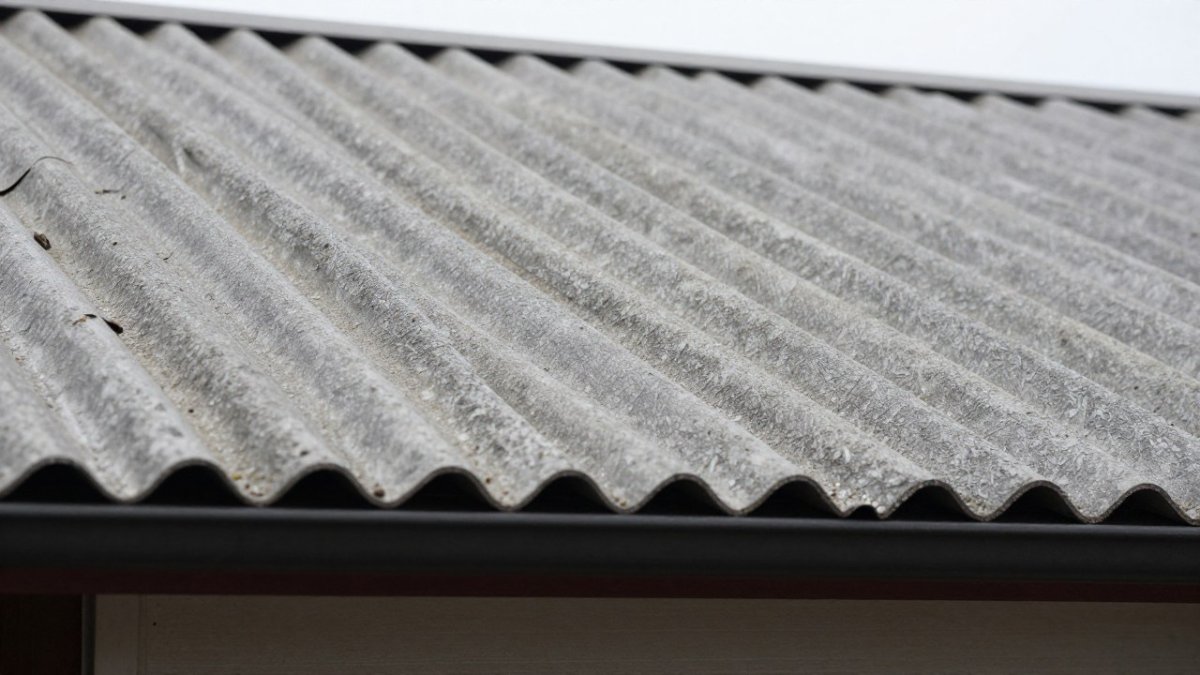
Asbestos cement was widely used in roofing between the 1950s and 1980s. Look for these signs:
- Grey, corrugated sheets with a dull, cement-like texture
- Sheets that are brittle, cracked or crumbling at the edges
- Fixings that have rusted, with white or grey dust around them
- A roof that looks flat and uniform rather than tiled
If your garage was built before the year 2000, treat the roof as suspect until proven otherwise. For a wider walkthrough of checking an older property, see our guide on how to check for asbestos in older homes.
Asbestos Cement Versus Other Asbestos-Containing Materials
Asbestos cement is the most common material in garage roofs, and it is also one of the lower-risk ACMs because the fibres are bound into the cement. That does not make it safe to break up.
Other ACMs can hide in the same garage:
- Asbestos insulating board in linings or partitions, which is far more friable than cement
- Textured coatings on ceilings or walls
- Ropes, gaskets and flashings around older roof structures
The difference matters because it changes who can remove the material. Cement sheets are usually handled by a competent contractor under controlled conditions. Asbestos insulating board is far more likely to require a licensed contractor. Misjudging which material you have is one of the most expensive mistakes in this work.
Planning an Asbestos Survey Before Roofing Work
Book the survey before you book the roofer. That sequence keeps the project moving and stops you paying for a job that has to be paused.
Use this pre-removal checklist:
- Confirm the garage build date and any past roof repairs
- Clear access to the roof and garage interior
- Tell the surveyor exactly what work is planned, including replacement
- Agree whether you need a refurbishment or management survey
- Ask for the report in writing, with sample locations and results
- Keep the report safe for future sales, lettings or disputes
A common mistake is ordering a survey without telling the surveyor what the roof work involves. A survey scoped for a sale is not the same as one scoped for full removal. Say what you plan to do, in detail.
What Your Asbestos Survey Report Should Contain
Your report should tell you, in plain terms, whether asbestos is present, where it is, what condition it is in, and what to do next. If any of those are missing, ask for a revised report.
A proper asbestos survey report includes:
- The survey type and the areas inspected
- Sample locations and laboratory test results
- A materials register with condition ratings
- Risk assessments and recommended control measures
- Clear recommendations for removal, repair or management
Checking Contractor Competence and Accreditation
Check three things before you book anyone: certification, accreditation and insurance. Ask for evidence, not assurances.
- Surveyor training: BOHS or UKATA certification for the individuals carrying out the survey
- Laboratory accreditation: ISO 17025 accreditation for the lab that tests your samples
- Insurance: current public and professional indemnity cover
- Method statement and risk assessment: written before work starts
Ask any provider for the same proof. If they hesitate, walk away.
Safe Removal, Licensing and Waste Disposal
Not all asbestos removal needs a licensed contractor, but all of it needs safe handling and a paper trail. The gap in most guides is that they tell you what should happen without telling you how to check it. This section does the checking.
Licensed versus non-licensed work
Licensing requirements depend on the material and the work involved. Ask your surveyor or the HSE which route applies to your roof before you appoint a contractor.
What to check before work starts
Ask for evidence, in writing, and keep it with your project file.
- Insurance: current public liability cover, and professional indemnity if they are also surveying. Ask for the certificate, not a verbal assurance.
- Training: asbestos awareness training for everyone on site, and the relevant competency certification for the individuals handling the material.
- Risk assessment and method statement: written before the work starts, specific to your roof, and covering access, dust suppression, PPE and waste handling.
- Waste-carrier registration: the contractor should be able to show registration as a waste carrier, or name the registered carrier they will use.
- Disposal facility: a permitted site that accepts hazardous waste. Ask which one.
A quote that is silent on all five is not a cheaper quote; it is an incomplete one.
On removal day
The controls you should expect to see are straightforward. The work area is segregated where practicable, dust is suppressed, sheets are handled rather than broken, and PPE is worn. Cement sheets are removed whole wherever possible because breaking them releases fibres. Waste is double-bagged, labelled and kept separate from general waste.
Watch out: if sheets are cracked or already damaged before work starts, the handling controls need to change. Do not let anyone hose down or sweep up debris as a casual clean-up; that is how fibres become airborne.
The paperwork you should receive
At the end of the job you should hold a waste transfer note or hazardous waste consignment note showing what was removed, how much, who carried it and where it went. Keep it. It is the evidence that the waste was disposed of lawfully, and it matters if the property is later sold or let. Fly-tipping asbestos waste is a serious offence, and the paperwork trail is what proves the waste went where it should.
DIY boundaries and damaged sheets
Removing asbestos cement yourself is not a task to take on casually. If sheets are intact and you are simply maintaining them, leave them alone. If they are cracked, broken or have been disturbed, keep people away from the area, avoid sweeping or hosing debris, and seek professional advice before doing anything else. The cautious response is always the cheaper one in the long run.
Asbestos Garage Roof Removal Cost: What Drives the Quote
Pricing depends on the job, not a fixed rate. For current prices or a quote for your garage roof, visit the Property Group website.
What drives the quote:
| Cost factor | Why it matters |
|---|---|
| Roof size | Single versus double garage changes labour and waste volume |
| Access | Height, obstructions and adjoining structures add time |
| Material type | Cement sheets cost less to remove than insulating board |
| Condition | Damaged sheets need more careful handling |
| Waste disposal | Hazardous waste charges vary by volume and facility |
| Reinstatement | Replacement roof adds materials and labour |
| VAT | Applied to the final invoice where applicable |
Ask for a written, itemised quote. It should separate survey, removal, disposal and reinstatement, so you can compare like for like.
Asbestos Garage Roof Replacement: Reinstatement Options
Once the old roof is down, you need something in its place. Reinstatement choices affect cost, lifespan and future maintenance.
- Corrugated metal sheets: durable, low maintenance, good for most garages
- GRP fibreglass: lightweight, seamless and long-lasting
- Felt flat roof: cheaper upfront, shorter lifespan
- Tiled or slate: heavier and more expensive, suited to certain structures
Choose based on how long you plan to keep the property and how much maintenance you want. For a rental, durability usually wins. For a quick sale, match the neighbouring properties.
Get a Quote for Your Garage Roof Survey
The order of operations is simple: identify, survey, remove, replace. Skipping the survey to save time is the one shortcut that reliably costs more later.
If you are planning garage roof removal, book the asbestos survey first. Property Group offers rapid 24/48 hour turnaround, BOHS and UKATA certified surveyors, and ISO 17025 accredited laboratory testing.
Get started with Property Group and move your roofing project forward with the paperwork already in place.
Removing a garage roof without knowing what is in it puts everyone at risk and can stall your project mid-job. Property Group provides accredited asbestos surveys with rapid turnaround and clear reporting, so you can plan removal and replacement with confidence.
Frequently Asked Questions
Do I need an asbestos survey before removing a garage roof?
In most cases, yes. Garage roofs built or refurbished before 2000 may contain asbestos cement, and you cannot confirm its absence by looking at it. A survey or targeted bulk sample gives you written evidence before work starts. If the roof is confirmed asbestos-free, removal can proceed normally. If asbestos is present, the survey report sets out the material type, condition and removal requirements so the work is planned safely and legally.
What type of asbestos survey is needed before garage roof removal?
For a planned removal, a refurbishment survey is usually the right choice because it is intrusive and locates asbestos in areas that will be disturbed. A management survey is less invasive and suits ongoing occupation rather than demolition. Where the roof is clearly asbestos cement and in good condition, many clients opt for targeted sampling of the sheets instead of a full survey. The right route depends on the scope of work and the building’s age.
How much does an asbestos survey for a garage roof cost?
Pricing depends on the size of the garage, the number of samples, access arrangements and turnaround time. A single garage with a handful of samples costs less than a double garage requiring a full refurbishment survey. Request a written quote that lists sampling, analysis and reporting separately so you can compare like for like.
Can I remove an asbestos garage roof myself?
Asbestos cement is lower risk than friable asbestos, but removal still generates dust and fibre release, and you must follow HSE guidance on control measures, respiratory protection and waste packaging. Damaged or broken sheets should never be handled by untrained people. Many homeowners choose a licensed or competent contractor for safe handling, and all asbestos waste must go to a permitted disposal facility via a licensed waste carrier with the correct waste transfer documentation.
