
Table of Contents
- How to Check for Asbestos in Older Homes: First Steps
- Common Asbestos-Containing Materials in Older Homes
- DIY Asbestos Testing Kits UK: What They Can and Cannot Do
- When to Call a Professional for an Asbestos Survey
- Asbestos Management Survey vs Refurbishment Survey: Which Do You Need?
- Asbestos Survey Cost: What Affects the Price
- Common Mistakes to Avoid When Checking for Asbestos
- Frequently Asked Questions
Last Updated: 21 September 2026
How to Check for Asbestos in Older Homes: First Steps
If your property was built or refurbished before the year 2000, asbestos could be present in its fabric. This guide from Property Group explains how to check for asbestos in older homes safely, and when to stop and call in a professional.
Asbestos is a group of naturally occurring fibrous minerals once used heavily in UK construction. The material was banned in stages, with blue and brown asbestos prohibited in 1985 and all remaining types banned in 1999 (HSE asbestos guidance(https://www.hse.gov.uk/asbestos/)). Any building constructed or refurbished before 2000 can still contain it.
The first rule of how to check for asbestos in older homes is this: you inspect with your eyes, not your hands.
Which Properties Are Most at Risk?
Age is the biggest clue, but it is not the only one. These properties carry the highest risk:
- Homes built between 1950 and 1999
- Any building refurbished before 2000
- Properties with old boiler cupboards, textured ceilings or cement roofs
- Buildings with original pipe lagging or floor tiles
A common mistake is assuming a modern-looking interior means the building is clear. Asbestos hides behind plasterboard, under carpets and above ceiling tiles.
Common Asbestos-Containing Materials in Older Homes
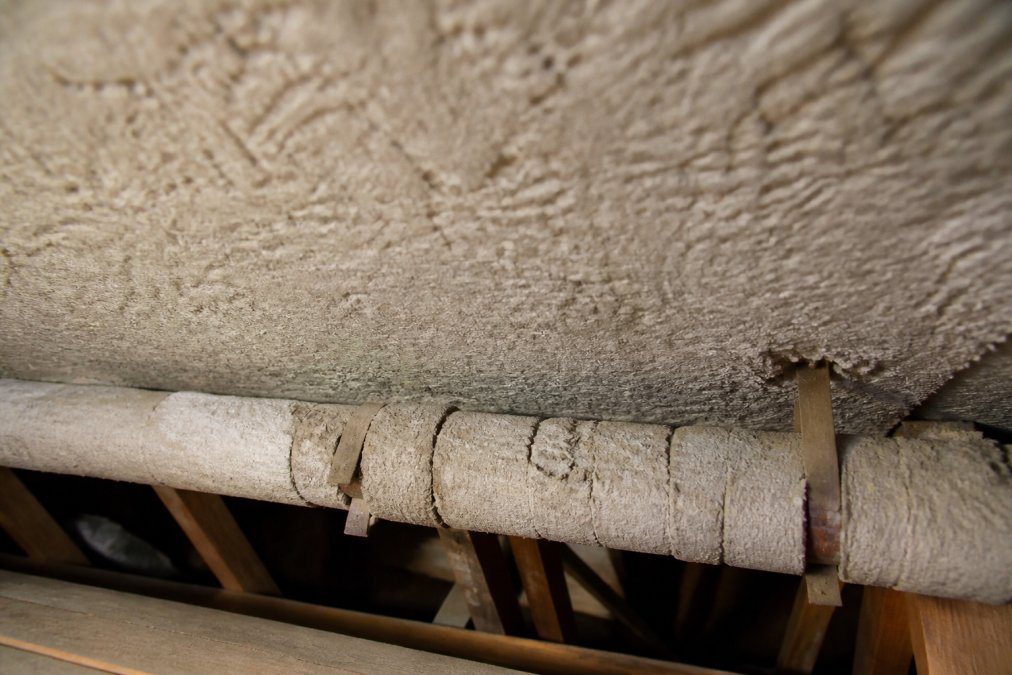
Asbestos was used in hundreds of building products, so knowing what to look for matters more than knowing the building’s age alone. It is most common in materials that needed heat resistance or strength.
Where Asbestos Hides: Room by Room
Asbestos turns up in predictable places. Check these areas first:
- Lofts: loose-fill insulation, pipe lagging, water tanks
- Kitchens: floor tiles, boiler flues, sink pads
- Bathrooms: wall panels, ceiling boards, sealants
- Garages: cement roofs, guttering, downpipes
- Exteriors: soffits, fascia boards, corrugated cement sheeting
Never drill, sand, cut or scrub any material you suspect contains asbestos. Disturbing it releases fibres into the air, and that is when the real health risk begins.
Breaking or drilling a suspected asbestos material releases fibres that can be inhaled. There is no safe level of exposure, so stop work immediately if you are unsure what a material contains.
DIY Asbestos Testing Kits UK: What They Can and Cannot Do
Asbestos testing kits UK suppliers sell let you take a small sample and post it to a lab for analysis. They can confirm whether a material contains asbestos, but they cannot tell you the extent of the problem or whether the material is safe to leave in place.
Here is what these kits can and cannot do:
| What the kit does | What the kit does not do |
|---|---|
| Tests one small sample | Surveys the whole property |
| Confirms presence of asbestos | Confirms the material’s condition |
| Gives a lab result | Advises on management or removal |
| Covers a single suspect area | Covers multiple materials |
A common mistake is sampling the wrong spot or disturbing fibres while taking the sample. If you use a kit, follow the instructions exactly and wear a suitable mask. For anything more than one or two suspect materials, a professional survey is the safer route.
When to Call a Professional for an Asbestos Survey
Call a professional surveyor whenever the material is damaged, you need to refurbish or demolish, or you cannot safely reach the suspect area. A qualified surveyor will inspect, sample and report without putting you or your family at risk.
At Property Group, our BOHS and UKATA certified surveyors carry out rapid assessments with a 24 to 48 hour turnaround. Samples go to ISO 17025 accredited laboratories, so the results hold up for legal and property purposes.
You should book a survey if:
- You are buying, selling or letting a pre-2000 property
- You plan a refurbishment, extension or demolition
- You find damaged or crumbly suspect material
- A previous survey is out of date or missing
Asbestos Management Survey vs Refurbishment Survey: Which Do You Need?
The type of survey you need depends on what you plan to do with the property. A management survey is for ongoing occupation, while a refurbishment survey is for work that will disturb the building fabric.
| Survey type | Purpose | When to choose it |
|---|---|---|
| Management survey | Locate and manage asbestos in place | Routine compliance, letting, maintenance |
| Refurbishment survey | Find all asbestos before work starts | Refurbishment, extension, demolition |
If you are simply maintaining a property, a management survey is usually enough. If you are knocking down walls or stripping out fittings, you need a refurbishment survey. Getting this wrong is one of the most common and costly mistakes.
Asbestos Survey Cost: What Affects the Price
Asbestos survey cost depends on the size of the property, the number of samples and the type of survey. There is no single figure, because a small flat and a large commercial unit are very different jobs.
The main factors that move the price are:
- Property size and number of rooms
- Number of samples the lab needs to test
- Management versus refurbishment survey
- Access difficulty, such as lofts and voids
- Whether the property is residential or commercial
For an accurate figure, request a quote based on your property details. Property Group provides clear, straightforward reports and honest advice, with no hidden extras.
Give the surveyor as much detail as possible when you book: property age, size and your planned works. A refurbishment survey quoted from vague details often needs re-quoting once the scope changes.
Common Mistakes to Avoid When Checking for Asbestos
Most asbestos problems come from good intentions and poor information. Avoiding these mistakes keeps you and your family safe.
- Assuming a pre-2000 home is automatically clear, or automatically dangerous
- Breaking, drilling or sanding suspect material to “test” it
- Taking a DIY sample without proper protection
- Relying on an old survey that predates your planned works
- Letting a refurbishment start before the survey report lands
- Choosing the cheapest quote without checking accreditation
Every one of these mistakes can turn a simple compliance job into a health risk or a legal problem.
The golden rule for how to check for asbestos in older homes: look, do not touch. Confirm with a lab or a certified surveyor before any material is disturbed.
Checking for asbestos in older homes is not a job for guesswork. If you are unsure, or your plans involve any disturbance to the building, the safe and legally sound step is a professional survey from a certified team.
Property Group can help. Our surveyors are BOHS and UKATA certified, our labs are ISO 17025 accredited, and we work fully in line with CAR 2012 legislation. We offer rapid 24 to 48 hour turnaround and clear, honest reports that stand up to scrutiny.
Get a quote from Property Group and secure your property with confidence.
Frequently Asked Questions
Can I test for asbestos myself?
You can use a DIY asbestos testing kit to take a sample and send it to an accredited lab. However, taking the sample yourself risks releasing fibres if not done carefully. For any material you suspect is friable or damaged, or if you are unsure, a professional surveyor is the safer option. Kits are best for intact materials in low-risk areas.
What does asbestos look like in an older house?
Asbestos is not visible to the naked eye as a distinctive substance. It appears in many forms: as white or grey corrugated sheeting, as fluffy loft insulation, as textured wall coatings, or mixed into cement products. You cannot confirm asbestos by appearance alone; laboratory testing or a surveyor’s assessment is required.
When should I hire a professional for an asbestos survey?
Hire a professional before any refurbishment, demolition, or major DIY work in a property built before 2000. Also, if you are a landlord or responsible for maintenance, you need a management survey. If you find damaged materials or plan structural changes, a refurbishment survey is required. Professional surveys ensure compliance with CAR 2012.
What is the typical asbestos survey cost?
Asbestos survey cost depends on property size, type, and whether you need a management or refurbishment survey. Prices also vary by location and access requirements. For an accurate quote, contact a qualified provider directly. Property Group offers rapid turnaround and can provide a tailored quote for your property.