
Last Updated: November 21, 2026
Quick Summary
A loft conversion asbestos survey is mandatory when the property is non-domestic, or when the work counts as refurbishment or demolition under the Control of Asbestos Regulations 2012. For a standard domestic loft conversion, the law does not name a survey outright, but the contractor’s duties mean a refurbishment survey is the normal way to proceed.
- The Control of Asbestos Regulations 2012 do not mention the year 2000; the trigger is disturbance, not the date on the deeds.
- A refurbishment and demolition survey is intrusive and area-specific, unlike a management survey which does not open up the building.
- Loft insulation, ceiling panels, roofing materials, water tanks and asbestos cement sheeting are common hiding places in lofts.
- Property Group offers 24/48-hour turnaround with BOHS and UKATA-certified surveyors and ISO 17025 accredited laboratories.
- If ACMs are found intact and will not be disturbed, leaving them in place is often the safest option.
Table of Contents
- Is an Asbestos Survey Mandatory for a Loft Conversion?
- Asbestos Survey Legal Requirements for Loft Conversions
- Why Pre-2000 Properties Carry the Highest Risk
- The Asbestos Refurbishment Survey for Loft Conversion Work
- Where Asbestos Hides in Lofts and Roof Spaces
- What an Asbestos Survey Cost Covers and What Affects the Quote
- What Happens If Asbestos Is Found During Refurbishment
- Who Arranges the Survey: Homeowners, Landlords and Contractors
- Frequently Asked Questions
Is an Asbestos Survey Mandatory for a Loft Conversion?
A loft conversion asbestos survey is not automatically mandatory for every loft conversion. The legal duty depends on who owns or controls the building and what the work involves.
That gap between “the law says” and “safety says” is where most confusion lives. Below, this guide breaks down when a survey is a legal requirement and when it is simply the sensible move.
Health and Safety Executive guidance on asbestos
Asbestos Survey Legal Requirements for Loft Conversions
The legal position turns on two things: the type of building and the type of work. Get those right and the rest follows.
The Control of Asbestos Regulations 2012 place a duty on anyone responsible for maintenance and repair of non-domestic premises (The Control of Asbestos Regulations 2012). That dutyholder must manage asbestos risk. A loft conversion in a commercial or shared building usually falls under this.
The Two Duties That Get Confused
Most of the confusion around loft conversions comes from conflating two separate duties in the Regulations.
- The duty to manage applies to non-domestic premises. The dutyholder, usually the owner, occupier or whoever has maintenance responsibility under a contract or tenancy, must find out whether asbestos is present, assess its condition, and put a management plan in place. This is what a management survey supports.
- The duty to identify before work applies more broadly. Regulation 5 requires an employer to identify the presence of asbestos, or assume it is present, before any work that may disturb the fabric of the building. This is not a duty to commission a survey by name; it is a duty to have reliable information before disturbance begins. In practice, for anything beyond minor work, an intrusive refurbishment survey is how that duty is discharged.
That distinction matters for a homeowner. If you are having a loft converted in your own home and no one is employed on the project in a way that engages Regulation 5, there is no single regulation that says “you must buy an asbestos survey”. But your contractor is an employer, and their duties under the same Regulations and under the Construction (Design and Management) Regulations 2015 mean they cannot safely start cutting into a pre-2000 roof without knowing what is in it.
When the Law Requires a Survey and When It Is a Safety Measure
Use this checklist to see where your project sits:
- Non-domestic building? A refurbishment and demolition survey is required before work disturbs the fabric.
- Shared or communal areas? The dutyholder must hold a management survey and share findings.
- Domestic property, pre-2000? No blanket legal requirement on the homeowner, but the contractor’s duties mean a refurbishment survey is the normal way to proceed.
- Work will cut, drill or remove materials? Disturbance risk makes a survey a practical necessity, and the contractor should not start without it.
- Selling or letting the property? Buyers and tenants increasingly expect documented clearance, and a landlord’s duty to manage extends to the whole property.
For a homeowner extending a loft, the survey is a safety measure, not a statutory demand on you personally. For a landlord or contractor, it edges much closer to a legal duty, and for a contractor it is effectively unavoidable.
Watch out: a common mistake is treating “pre-2000” as a legal threshold. It is not. The Regulations do not mention 2000. The year is a practical heuristic based on when asbestos use in construction fell away, and a building put up in 1999 is not automatically riskier than one refurbished in 2001.
Health and Safety Executive guidance on asbestos
Use this checklist to see where your project sits.
| Situation | Position on a survey |
|---|---|
| Non-domestic building | Refurbishment and demolition survey required before work disturbs fabric |
| Shared or communal areas | Dutyholder must hold a management survey and share findings |
| Domestic property, pre-2000 | No blanket legal requirement on homeowner; refurbishment survey is normal |
| Work will cut, drill or remove materials | Disturbance risk makes a survey a practical necessity |
| Selling or letting the property | Buyers and tenants expect documented clearance; landlord duty extends to whole property |
Why Pre-2000 Properties Carry the Highest Risk
Any building constructed or refurbished before 2000 could contain asbestos. The material was used widely in construction until it was banned, and it still sits in millions of older homes.
The risk rises with property age. A 1960s semi is far more likely to hide asbestos than a 2005 new-build. That is why we treat pre-2000 properties as the default high-risk group.
Loft insulation, ceiling panels and roofing materials are common hiding places. Disturbing them during a conversion can release asbestos fibres into the air.
The Asbestos Refurbishment Survey for Loft Conversion Work
A refurbishment and demolition survey is the intrusive inspection you need before building work begins. It is fully intrusive and looks specifically at the areas your project will disturb.
This is different from a routine check. The surveyor opens up the building fabric, takes samples and sends them for laboratory analysis. You get a survey report listing any asbestos-containing materials (ACMs) found.
Turnaround matters when a project is waiting.
How a Refurbishment Survey Differs from a Management Survey
A management survey is the lighter option. It locates ACMs that could be disturbed during normal occupation and day-to-day maintenance. It does not open up the building.
A refurbishment survey goes further. It is intrusive, area-specific and designed around your planned works. If your loft conversion will cut into ceilings or roof timbers, you need the refurbishment type, not the management one.
Where Asbestos Hides in Lofts and Roof Spaces
Lofts are one of the most common places to find asbestos in older properties, which is why loft conversion asbestos checks matter. The space is rarely disturbed, so materials sit untouched for decades.
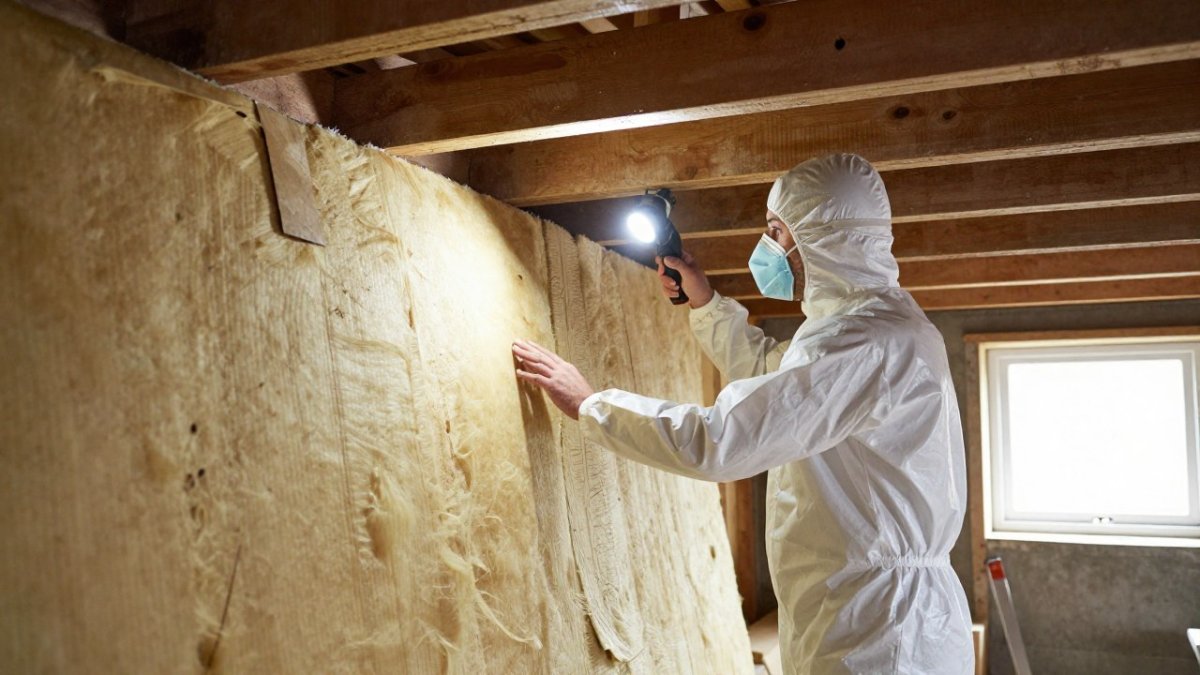
Common locations include:
- Loft insulation in loose or board form
- Ceiling panels and textured coatings
- Roofing materials and felt
- Water tanks and pipe lagging
- Asbestos cement sheeting on roof structures
If you are unsure whether your home contains asbestos, our guide on how to check for asbestos in older homes walks through the practical steps.
What an Asbestos Survey Cost Covers and What Affects the Quote
Asbestos survey cost depends on several factors, not a single flat rate. We do not publish fixed prices because every property is different, but we can be specific about what drives the number so you can budget sensibly.
What the Quote Is Actually Paying For
A survey quote is rarely just “a visit”. It may bundle:
- Surveyor time on site, the time needed depends on access and how much fabric has to be opened up.
- Sample analysis, each sample sent to a laboratory is typically charged individually; the charge depends on the laboratory and turnaround.
- Report production, the written survey report, register of asbestos-containing materials and recommendations.
- Access equipment, ladders, crawl boards, sometimes scaffolding or a tower if the roof space is awkward or the surveyor cannot safely reach areas.
- Travel and mobilisation, more significant for rural or remote properties.
What Moves the Number Most
- Property size and number of rooms, more rooms means more areas to inspect and more samples.
- Access limitations in the loft or roof space, a boarded, well-lit loft is quicker than a cramped, unboarded one.
- Survey scope and how intrusive it needs to be, a management survey is cheaper than a refurbishment survey because it does not open up the fabric.
- Number of samples taken for laboratory analysis, this is often the single biggest variable on a refurbishment survey.
- Survey turnaround you need, a 24/48-hour turnaround carries a premium over a standard five-to-ten working day service.
Turnaround and Booking
Property Group offers 24/48-hour turnaround, with BOHS and UKATA-certified surveyors and ISO 17025 accredited laboratories behind every sample. Expect to pay more for a priority slot; for current pricing, please check the Property Group website or request a quote.
Watch out: the cheapest quote is often cheap because it excludes sample analysis or limits the number of samples. Check what is included before comparing totals, or you may end up paying twice.
For an accurate figure, request a quote based on your property and the scope of your planned conversion.
What Happens If Asbestos Is Found During Refurbishment
Finding asbestos is not the end of your project. It changes the plan, not the goal.
If ACMs are found, the survey report tells you where they are and what condition they are in. From there:
- Leave it in place if it is intact and will not be disturbed. This is often the safest option.
- Encapsulate or repair to seal the material.
- Remove it using licensed contractors where the law requires licensed removal.
Removal is not always necessary. Disturbing intact asbestos is often riskier than leaving it alone. The honest next step depends on the survey findings.
Who Arranges the Survey: Homeowners, Landlords and Contractors
Responsibility depends on your role. A homeowner commissioning a loft conversion arranges the survey to protect themselves and the project.
Contractors working on the building share the duty to avoid disturbing asbestos. Under the Construction (Design and Management) Regulations 2015, they must plan work with asbestos risk in mind.
A common mistake is assuming someone else has it covered. In practice, the person commissioning the work should confirm a survey is in place before anyone drills a hole.
A loft conversion is a big investment, and asbestos should never derail it.
Frequently Asked Questions
Is an asbestos survey legally required before a loft conversion?
There is no single law that says every loft conversion needs a survey. The duty to manage asbestos under the Control of Asbestos Regulations 2012 applies to non-domestic premises, and construction work is covered by CDM 2015. In practice, any conversion that disturbs the building fabric of a pre-2000 property should have a refurbishment survey before work starts. Skipping it leaves you and your contractor exposed to risk and can halt the project mid-build.
Which type of asbestos survey is needed for a loft conversion?
A refurbishment and demolition survey is the right choice. It is intrusive, targets the areas that will be altered, and involves sampling and laboratory analysis so materials are identified rather than presumed. A management survey is not enough because it assumes the building stays in use and does not open up concealed spaces. Tell the surveyor exactly what the conversion involves so the survey scope matches the work area.
What happens if asbestos is found during a loft conversion?
Work in that area stops until the material is dealt with. The survey report will state the type, condition and location, and your contractor should update the risk assessment. Some materials can be left in place if they are in good condition and will not be disturbed, with the findings recorded and shared. Licensed removal is needed for the higher-risk materials, and a clearance certificate is issued before work resumes.
How much does an asbestos survey cost for a loft conversion?
Pricing depends on the size of the property, the number of samples taken, access to the roof space and how quickly you need results. A single loft area is a smaller job than a full refurbishment survey across a whole house. Accredited providers such as Property Group can confirm a figure once they know the scope. Ask for a quote that states the number of samples and the turnaround time in writing.
