
Last Updated: 14 November 2026
Quick Summary
You need an asbestos survey before a kitchen refit if the property was built or refurbished before 2000 and the work will disturb walls, floors or ceilings. Any renovation involving drilling, removing or cutting into building fabric should be preceded by a refurbishment and demolition asbestos survey.
- Asbestos was widely used in building materials until its use was banned in the UK.
- A management survey is non-intrusive and will not give the detail needed to disturb building fabric safely.
- Asbestos in kitchen floor tiles, along with the adhesive beneath them, is a common find in older properties.
- If asbestos is found, stop work immediately, keep people out and do not attempt removal yourself.
- Property Group offers rapid 24/48 hour turnaround with BOHS and UKATA qualified surveyors.
Table of Contents
- Do You Need an Asbestos Survey for a Kitchen Refit?
- How a Refurbishment and Demolition Asbestos Survey Differs from a Management Survey
- Asbestos in Kitchen Floor Tiles and Other Hidden Materials
- What Happens If Asbestos Is Found During Renovation
- What an Asbestos Survey Costs and How Long It Takes
- Homeowner, Landlord and Contractor Responsibilities for a Kitchen Refit
- Book Your Kitchen Refit Asbestos Survey with Property Group
- Frequently Asked Questions
Do You Need an Asbestos Survey for a Kitchen Refit?
If your kitchen refit will disturb the fabric of a building constructed before 2000, you almost certainly need an asbestos survey before work starts. The short version is this: any kitchen renovation that involves drilling, removing or cutting into walls, floors or ceilings should be preceded by a refurbishment and demolition asbestos survey. The Health and Safety Executive guidance on asbestos in refurbishment is clear that building work which disturbs asbestos-containing materials puts everyone on site at risk.
The answer depends on the age of the property, the scope of the work, and who is legally responsible. Below, we’ll show you exactly how to work out whether you need an asbestos survey, what it involves, and what to do if something is found.
Asbestos survey is a formal inspection of a building to identify and assess asbestos-containing materials before work disturbs them. It produces a report you can rely on for planning, compliance and safety.
When a Survey Is a Legal Requirement
The legal duty to manage asbestos in non-domestic premises comes from the Control of Asbestos Regulations 2012. For domestic properties, the picture differs depending on whether you are a homeowner, landlord or contractor. Here is a quick checklist of when a survey is legally required or strongly advised before a kitchen refit:
- You are a landlord and the property was built or refurbished before 2000
- You are a contractor carrying out refurbishment work and cannot prove the absence of asbestos
- The kitchen refit involves demolition, drilling or removing building fabric
- You are selling or letting the property and need due diligence
- A previous survey is missing, out of date, or does not cover the areas being worked on
The regulations place a duty on those responsible for maintenance and repair to manage asbestos risk.
Why Pre-2000 Properties Change the Answer
Age is the single biggest factor in whether you need a survey. Asbestos was widely used in building materials until its use was banned in the UK. Any property built, extended or refurbished before 2000 could contain it.
A common mistake is assuming a modern-looking kitchen means a modern building. Cosmetic updates hide original walls, floors and ceilings. If you’re unsure about your property, our guide on how to check for asbestos in older homes walks through the practical steps before you start work.
How a Refurbishment and Demolition Asbestos Survey Differs from a Management Survey
A refurbishment and demolition asbestos survey is an intrusive inspection carried out before building work, while a management survey is a non-intrusive check for ongoing occupation. The difference matters because a management survey will not give you the detail you need to disturb building fabric safely.
A management survey locates asbestos that could be disturbed during normal use. A refurbishment survey goes further: it opens up the building fabric in the areas due for work, so it can find materials hidden behind plasterboard, under floors and above ceilings.
Intrusive Inspection and Building Fabric
Intrusive inspection means the surveyor physically accesses concealed spaces. That may involve lifting floorboards, removing ceiling tiles or taking small samples. This is the only way to confirm what is inside the building fabric before a kitchen renovation disturbs it.
For a full demolition, a demolition survey is the appropriate scope for work that will take the building down.
Asbestos in Kitchen Floor Tiles and Other Hidden Materials
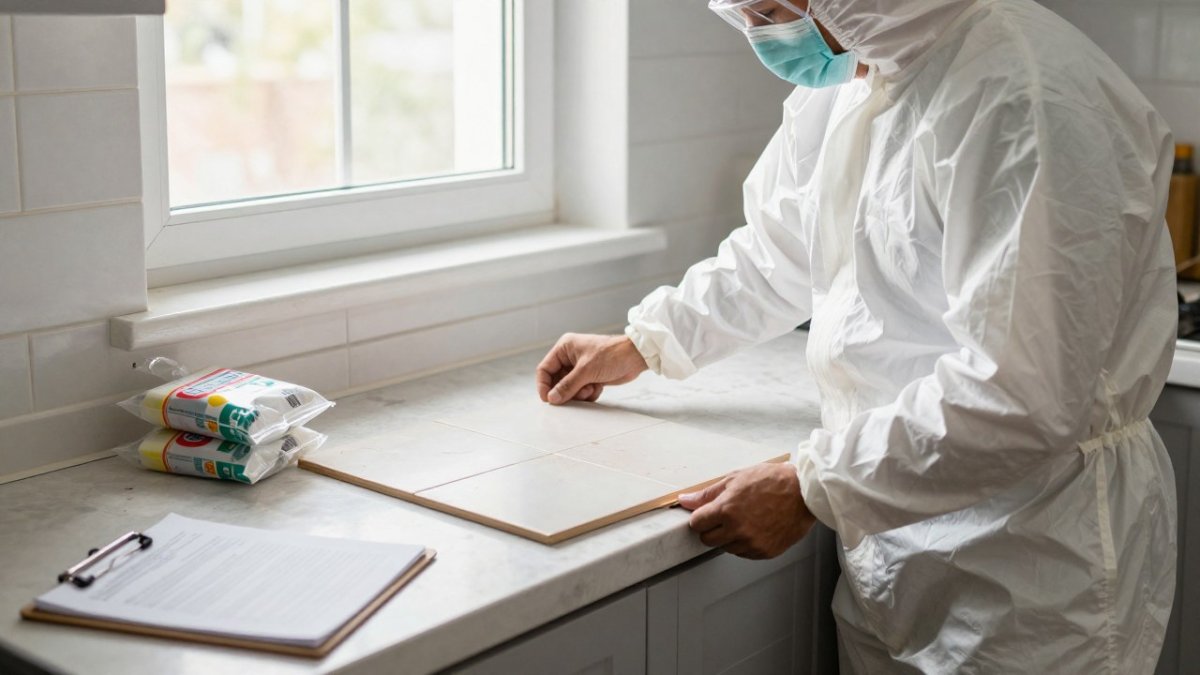
Asbestos in kitchen floor tiles is one of the most common finds in older properties. Vinyl and thermoplastic tiles, along with the adhesive beneath them, frequently contain asbestos. They look harmless until a fitter lifts them.
Other hidden spots we regularly find in kitchens include:
- Textured coatings on ceilings and walls
- Asbestos insulating board behind cookers and splashbacks
- Pipe lagging and boiler flues
- Sealants and old panel boards
- Materials inside boxing around services
Where Kitchen Refits Disturb ACMs
Refurbishment work disturbs asbestos-containing materials the moment a tool touches them. Drilling into board, removing tiles, cutting into boxing or pulling out old units all release fibres if ACMs are present. You cannot tell asbestos by looking at it, which is why material identification through sampling and laboratory analysis matters.
What Happens If Asbestos Is Found During Renovation
If asbestos is found during renovation, the first priority is to stop work in that area immediately. The survey report will recommend one of three options: leave in place, encapsulate, or remove. The right choice depends on the material’s condition and whether your work will disturb it. Leaving in place is valid when the material is in good condition and will not be disturbed. Encapsulation seals it so fibres cannot escape. Removal is required when the material will be disturbed or is already damaged.
But the more common scenario is that suspected material is uncovered mid-project, before any survey has been done. Here is what to do:
- Stop work immediately in the affected area. Do not continue drilling, cutting or removing anything nearby.
- Keep people out of the area. Close the door if possible and put up a warning sign if you have one. Do not let anyone sweep up or use a vacuum cleaner on the debris, as this can spread fibres.
- Do not attempt to remove the material yourself. Even small amounts of suspect material should be assessed by a competent person.
- Arrange an assessment, either by a qualified asbestos surveyor or, if the material is already damaged and needs removal, by a licensed contractor. The HSE guidance on asbestos removal explains when a licensed contractor is legally required.
- Inform others, your contractor, other trades on site, and anyone living in the property. If the material is in a kitchen, you may need to arrange alternative cooking arrangements until the area is cleared.
Watch out: if the material is friable, crumbly, easily broken or already damaged, the risk of fibre release is higher, and you should treat it as a priority. Do not wait for the project to finish; arrange an assessment as soon as possible. Trying to save time by working around suspect material is the mistake that turns a small job into a serious incident.
Once the assessment is complete, the surveyor or contractor will advise on whether the material can be left in place and worked around, encapsulated, or removed. If removal is needed, the project timeline will need to accommodate it, and you should factor in the cost and any licensing requirements before work resumes.
What an Asbestos Survey Costs and How Long It Takes
Asbestos survey cost depends on the scope of the property and the work, and how intrusive the inspection needs to be. Pricing depends on the specific requirements, so please check the Property Group website or request a quote for current prices. The HSE’s guidance on managing asbestos explains why scope, not floor area alone, drives the work.
Turnaround is where planning pays off. At Property Group, we offer rapid 24/48 hour turnaround, and our reports are produced by BOHS and UKATA qualified surveyors using ISO 17025 accredited laboratories.
| Survey Type | Best For | Intrusive? | Typical Use |
|---|---|---|---|
| Management survey | Ongoing occupation and maintenance | No | Landlords, property managers |
| Refurbishment survey | Kitchen refits and renovation work | Yes | Homeowners, builders |
| Demolition survey | Full building removal | Yes, full scope | Developers, contractors |
Homeowner, Landlord and Contractor Responsibilities for a Kitchen Refit
Responsibility splits three ways, and each party carries a different duty. Homeowners must not expose contractors to risk and should disclose any known asbestos. Landlords carry the duty to manage under CAR 2012 for common areas and, in practice, should hold current survey records. Contractors and kitchen fitters must plan for asbestos before starting work and stop if they suspect it.
A common mistake is assuming the builder will “sort it”. The contractor has a legal duty to protect workers, but the property owner often holds the information about the building. Share any existing survey reports, and if none exist, commission one before the first unit comes off the wall.
Book Your Kitchen Refit Asbestos Survey with Property Group
The safest route through a kitchen renovation is to know what is in the building before anyone picks up a drill. Property Group provides accredited asbestos surveys with clear reports and honest advice, supporting compliance with CAR 2012. Our surveyors are BOHS and UKATA certified, and our laboratories are ISO 17025 accredited. We help you meet your legal responsibilities and reduce health risks from asbestos exposure.
Get started with Property Group and request a quote.
A kitchen refit should end with a finished room, not a stalled site and a remediation bill. If your property predates 2000 and you are about to disturb walls, floors or ceilings, arrange your survey first. Property Group offers rapid 24/48 hour turnaround, BOHS and UKATA certified surveyors, and reports backed by ISO 17025 accredited laboratories. Get a quote today and renovate with confidence.
Frequently Asked Questions
Do I need an asbestos survey if I am only replacing kitchen units?
It depends on what the work disturbs. Swapping like-for-like units without touching walls, floors or ceilings may be low risk, but drilling into walls to fix new cabinets, removing old splashbacks or lifting flooring can release fibres from asbestos-containing materials. In a pre-2000 property, a refurbishment survey is the safest way to confirm what is present before your fitter starts. If you are unsure, ask a competent surveyor to assess the planned work area first.
Can a builder start work before an asbestos survey is completed?
No. Under the Control of Asbestos Regulations 2012, refurbishment work that may disturb building fabric should not begin until an asbestos survey has identified the materials present. Starting early risks fibre release, endangers workers and occupants, and can lead to enforcement action. Schedule the survey before demolition or strip-out begins, and share the report with your contractor so safe working practices can be planned around any ACMs found.
Does a home built before 2000 need an asbestos survey before renovation?
Not every pre-2000 home needs a full survey, but any kitchen refit that disturbs building fabric should be assessed. Asbestos was widely used in building materials until it was banned in 1999, so properties built or refurbished before 2000 carry a real risk. A refurbishment survey is the appropriate type for planned work, as it targets the areas your project will affect. A management survey is better suited to ongoing occupation and maintenance.
What should I do if asbestos is found during a kitchen refit?
Stop work immediately and keep everyone out of the affected area. Do not drill, cut or remove the material yourself. Your survey report should identify the ACM and its condition; a licensed contractor is required for most high-risk removal work. In some cases the material can be left in place and worked around, or encapsulated. Property Group can advise on next steps and help you schedule any follow-up testing or removal so your project timeline stays on track.
